Best Email Verification Tools for Cold Email in 2026 (Compared & Reviewed)
If you’re running cold email campaigns, the quality of your prospect data matters just as much as your targeting and messaging. Invalid, outdated, risky, or incorrectly formatted email addresses can create unnecessary bounces before your outreach has a chance to perform.
The best email verification tools for cold email help identify potentially invalid, disposable, catch-all, unknown, or risky addresses before they enter an active campaign.
For agencies, SDR teams, SaaS companies, and B2B businesses, email verification should be treated as a quality-control step within the outbound workflow rather than a guarantee of delivery.
Verification tools can reduce the risk of sending to obviously invalid addresses, but no platform can guarantee that every verified email will successfully reach the recipient. Mailboxes change, employees leave companies, catch-all domains create uncertainty, and receiving servers make their own delivery decisions.
In this guide, we’ll compare some of the best email verification tools for cold outreach, explain how verification works, and help you decide which platform fits your list size, workflow, budget, and verification requirements.
In this guide, you’ll learn:
- Why email verification matters
- How email verification works
- What features to look for
- The best email verification tools in 2026
- Which tools are best for agencies, SDR teams, and growing businesses
- Common mistakes to avoid when cleaning email lists
Whether you’re sending 500 or 100,000 cold emails each month, choosing the right verification tool can save time, reduce costs, and improve campaign performance.
What Is Email Verification?
Email verification is the process of evaluating whether an email address appears valid and deliverable before using it in an outreach campaign.
An email verification platform may perform several checks, including:
- Email syntax validation
- Domain validation
- MX record checks
- SMTP-related validation
- Disposable email detection
- Catch-all domain identification
- Role-based email detection
- Duplicate detection
- Risk or status classification
After these checks, the platform typically classifies an address using labels such as valid, invalid, unknown, risky, or catch-all.
These results help outbound teams decide which contacts can move directly into a campaign and which ones may need additional review.
However, verification is not the same as guaranteed delivery. It provides a point-in-time assessment of the address and should be combined with good list hygiene and campaign monitoring.
Why Email Verification Matters for Cold Outreach
Cold outreach depends on accurate prospect data. Even strong targeting and messaging cannot compensate for a list containing large numbers of invalid, outdated, or unreachable addresses.
Verification helps reduce avoidable risk before sending by identifying contacts that may need to be removed or reviewed.
Reduce Avoidable Hard Bounces
Sending to email addresses that do not exist can create hard bounces that could often have been prevented before a campaign launched.
Verification helps identify clearly invalid addresses so they can be removed from your sending list before outreach begins.
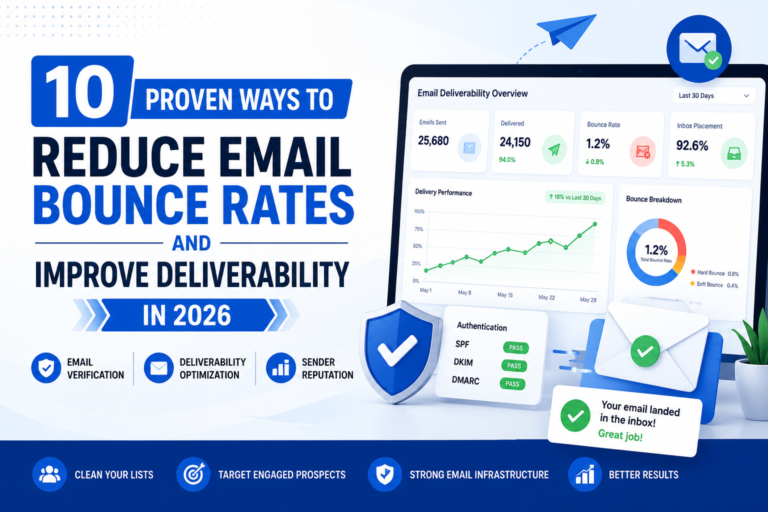
If you’re already experiencing bounce problems, see our guide on how to reduce email bounce rates in cold outreach for additional steps covering list quality, verification, infrastructure, and monitoring.
Support Better Deliverability
Email verification cannot guarantee inbox placement, but it can remove one avoidable source of deliverability problems: sending repeatedly to addresses that are clearly invalid.
Deliverability also depends on factors such as:
- Sending-domain reputation
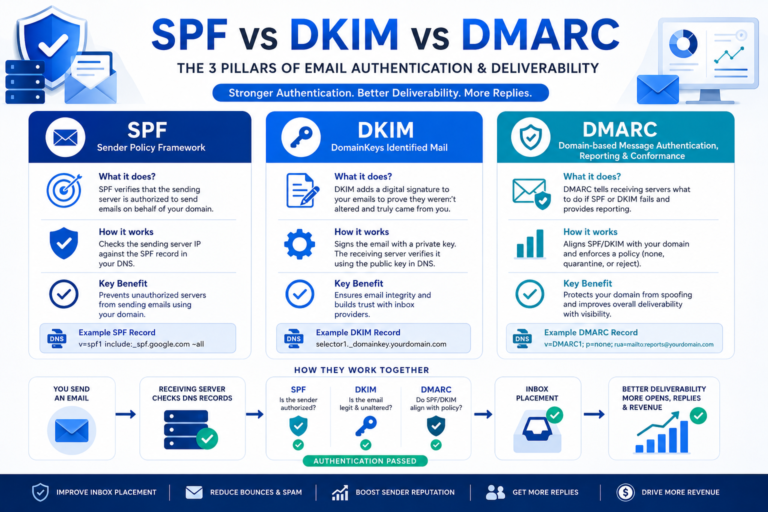
- SPF, DKIM, and DMARC configuration
- Mailbox reputation
- Sending behavior
- Message content
- Recipient engagement
- Complaint and bounce patterns
Verification therefore works best as one part of a broader cold email deliverability process.
Avoid Wasting Outreach on Invalid Contacts
Email verification does not improve your offer, copy, targeting, or follow-up strategy.
What it can do is help prevent campaign capacity from being wasted on addresses that are clearly invalid or unlikely to receive your message.
Reply performance still depends primarily on whether you’re reaching the right prospect with a relevant message and offer.
Lower Outreach Costs
Most cold email platforms charge based on contacts, emails sent, or credits consumed. Sending emails to invalid addresses means you’re paying for messages that have no chance of generating results. Cleaning your list first helps maximize the value of your outreach budget.
How Email Verification Works
Email verification tools usually combine multiple technical and data-quality checks rather than relying on one signal.
The exact process varies between providers, which is one reason two verification platforms may occasionally return different results for the same address.
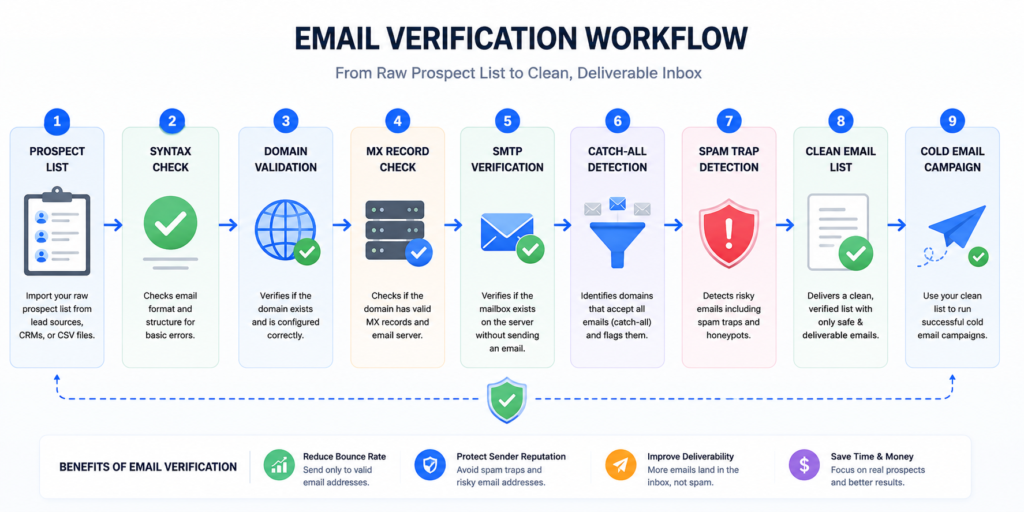
A typical verification workflow may include:
| Step | What Happens | Why It Matters |
|---|---|---|
| Syntax Check | Verifies email formatting | Removes obvious invalid emails |
| Domain Validation | Confirms the domain exists | Prevents sending to inactive domains |
| MX Record Check | Confirms mail server availability | Ensures the domain accepts email |
| SMTP Validation | Checks mailbox existence without sending an email | Identifies inactive recipients |
| Catch-All Detection | Detects domains that accept all addresses | Helps assess verification confidence |
| Spam Trap Detection | Flags known risky addresses | Protects sender reputation |
| Role-Based Detection | Identifies generic business emails | Helps improve targeting quality |
The final result should be treated as a risk classification rather than an absolute guarantee. This is especially important for catch-all and unknown addresses, where verification confidence is naturally lower.
Why Do Verified Emails Still Bounce?
One of the most common misunderstandings about email verification is assuming that a “valid” result guarantees successful delivery.
It doesn’t.
An email can pass verification and still bounce later because:
- The employee left the company after the verification check
- The mailbox was disabled
- The mailbox became full
- The receiving server temporarily rejected the message
- A catch-all domain accepted verification checks but rejected the actual recipient
- The sender was blocked or rejected by the receiving system
- The verification provider incorrectly classified an uncertain address
Email verification is therefore best viewed as a pre-send risk-reduction step, not a guarantee that every verified address will accept every message.
If verified contacts repeatedly bounce, review both your prospect data and your sending infrastructure instead of assuming that list verification alone will solve the issue.
Should You Double-Verify Cold Email Addresses?
Double verification means checking an address with a second verification provider, usually when the first result is uncertain.
It can be useful for:
- Catch-all addresses
- Unknown results
- Older prospect lists
- High-value contacts
- Data coming from less reliable sources
However, running every contact through two verification tools is not automatically necessary.
A more practical approach is to use secondary verification selectively for addresses where the first result leaves meaningful uncertainty.
Best Email Verification Tools for Cold Email in 2026
The best email verification tool for cold outreach depends on how you build prospect lists, how many addresses you verify, how you handle catch-all or unknown results, which integrations you need, and how much you are willing to spend per verification.
Instead of assuming one platform is best for every business, compare tools based on the specific verification workflow you need.
Below are five platforms worth evaluating for cold email list verification.
1. ZeroBounce
Best for: Businesses prioritizing deliverability and detailed email quality insights.
Key Features
- Bulk email verification
- Email scoring
- Spam trap detection
- Abuse email detection
- Catch-all detection
- Email activity data
- API access
Why It Stands Out
ZeroBounce provides more than a simple “valid” or “invalid” result. It also offers insights into risky addresses, helping you make informed decisions about which contacts to include in your campaigns.
- Ideal For
- B2B SaaS
- Marketing agencies
- High-volume outbound teams
- Enterprise sales
2. NeverBounce
Best for: Large email databases that require frequent cleaning.
Key Features
- Real-time verification
- Bulk verification
- CRM integrations
- Automatic list cleaning
- API support
Why It Stands Out
NeverBounce is known for processing large datasets quickly, making it a practical option for agencies managing multiple client lists.
- Ideal For
- Lead generation agencies
- Sales teams
- CRM-driven businesses
3. MillionVerifier
Best for: Affordable bulk email verification.
Key Features
- Competitive pricing
- Bulk verification
- Catch-all detection
- Duplicate removal
- API access
Why It Stands Out
MillionVerifier offers strong value for businesses sending moderate to high volumes of cold emails without the higher cost of enterprise platforms.
- Ideal For
- Startups
- Freelancers
- Small agencies
4. Bouncer
Best for: GDPR-conscious businesses and European companies.
Key Features
- Bulk verification
- API
- Team collaboration
- Deliverability toolkit
- Integrations
Why It Stands Out
Bouncer combines an intuitive interface with reliable verification accuracy and a strong focus on data privacy.
- Ideal For
- European agencies
- SaaS companies
- Growing sales teams
5. Verifalia
Best for: Developers and API-driven workflows.
Key Features
- REST API
- Bulk verification
- Real-time verification
- Flexible integrations
- High scalability
Why It Stands Out
Verifalia is well suited for businesses integrating email verification directly into custom applications or automated lead generation workflows.
- Ideal For
- Developers
- Product companies
- SaaS platforms
Best Email Verification Tools for Cold Email: Quick Comparison Table
| Tool | Best For | Useful When |
|---|---|---|
| ZeroBounce | Detailed verification insights | You want additional classification and data-quality signals |
| NeverBounce | Larger list-cleaning workflows | You regularly verify bulk contact databases |
| MillionVerifier | Cost-conscious bulk verification | Verification volume and cost matter |
| Bouncer | Flexible verification workflows | You need bulk, API or integration options |
| Verifalia | API-driven verification | You’re incorporating verification into an automated workflow |
Which Email Verification Tool Should You Choose?
| If You Are… | Recommended Tool |
|---|---|
| Marketing Agency | NeverBounce or ZeroBounce |
| Lead Generation Agency | MillionVerifier |
| SaaS Company | ZeroBounce |
| SDR Team | NeverBounce |
| Startup | MillionVerifier |
| Enterprise | ZeroBounce |
| Developer | Verifalia |
| GDPR-Focused Business | Bouncer |
No single tool is the perfect choice for every business. Consider your monthly verification volume, required integrations, and budget before making a decision.
Recommended Email Verification Workflow for Cold Outreach
Instead of verifying emails only when problems arise, make verification a standard step in your outbound process.
A practical workflow looks like this:
This approach helps maintain a healthy sender reputation over time.
Recommended Cold Email Stack
| Category | Recommended Tool |
|---|---|
| Lead Database | Apollo.io |
| Email Verification | ZeroBounce / NeverBounce |
| Email Sending | Instantly |
| Multi-Mailbox Outreach | Smartlead |
| CRM | HubSpot |
| DNS Monitoring | MXToolbox |
Final Thoughts on the Best Email Verification Tools for Cold Email
The best email verification tools for cold email help reduce risky and invalid addresses before outreach begins. Choose a platform based on your list size, verification needs, integrations, and budget. Remember that verification works best alongside clean prospect data, proper email infrastructure, and ongoing deliverability monitoring.
Frequently Asked Questions About Email Verification for Cold Email
Why should I verify my email list before sending cold emails?
Email verification helps identify invalid, risky, or outdated email addresses, reducing hard bounce rates and supporting better deliverability.
How often should I verify my email lists?
It’s a good practice to verify every new list before sending and to re-verify older lists if they haven’t been used for several months.
Can email verification improve reply rates?
Verification doesn’t improve your email copy, but it helps ensure your messages reach valid inboxes, increasing the opportunity for replies.
Are catch-all email addresses safe to contact?
Catch-all addresses are more difficult to validate. Some are legitimate, while others may never reach an active recipient. Consider testing them separately and monitoring results.
What’s the difference between email verification and email authentication?
Email verification checks whether an email address is valid, while email authentication (using SPF, DKIM, and DMARC) helps mailbox providers trust your sending domain. Both are important for successful cold email campaigns.